

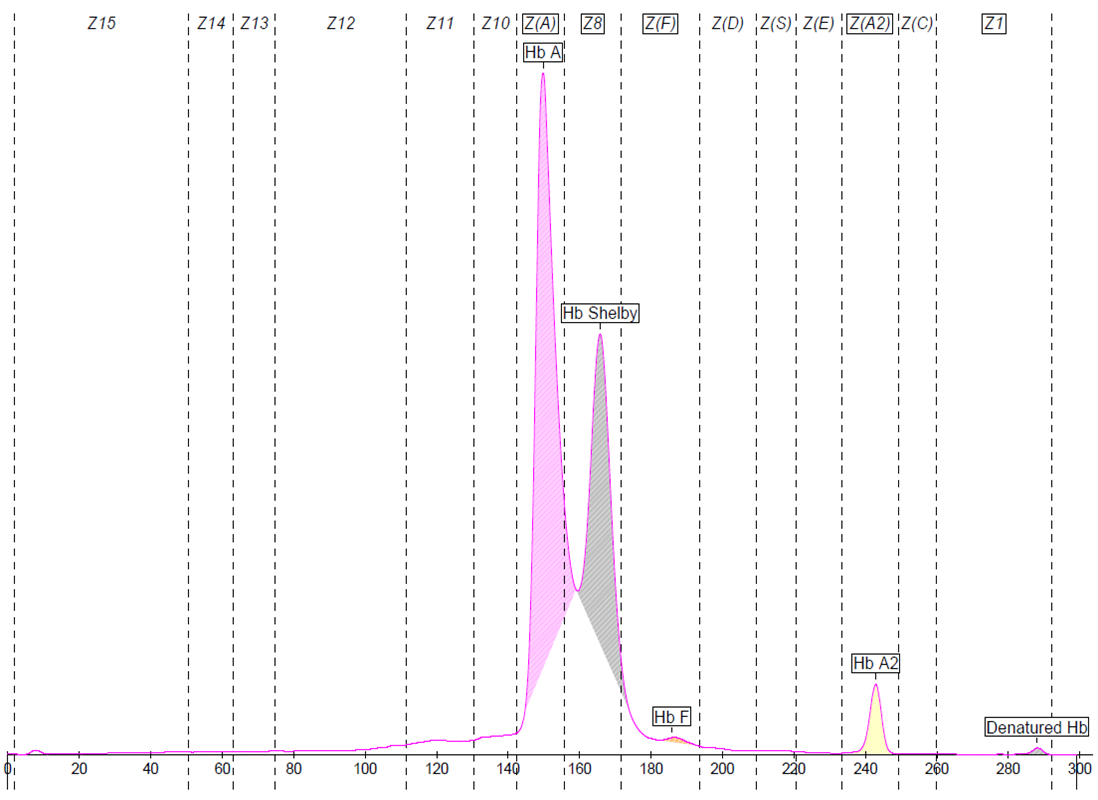
General information
Globin chain involved
Status
Heterozygous
Migration zones
Migration positions
166
Sickle Cell Disease: No
Thalassemic variant: No
Capillary Electrophoresis
Fractions
Value %
Hb A
61.7
Hb Shelby
32.5
Hb F
0.5
Hb A2
5.0
Denatured Hb
0.3
Comments
The mildly unstable Hb Shelby variant leads to an additional denatured fraction in Z1 zone.
Hb A2 is overestimated due to partial loss of integration of Hb A and Hb Shelby. It is recommended to delete the automatic quantification of both peaks and then manually quantify them together to obtain a correct estimate of Hb A2 (here 3.3%).
Mutation data
Heterozygous Hb Shelby
Mutation
HGVS Nomenclature
Beta 131(H9) Gln>Lys
HBB:c.394C>A
Hematological parameters
Name
Result
RBC Count
Normal
Total Hemoglobin
Normal
MCV
Normal
MCH
Normal
Blood smear
Increased target cells
Other analysis
Normal Hematocrit
Comments on hematology
Normal
Clinical context
Clinical presentation
Normal
Clinical risk
May induce intermediate anemia when associated with beta0-thalassemia, but without consequence when associated with Hb S
Variant information
Stability
Mildly unstable
Oxygen affinity
Slightly decreased
Ethnicities in literature
Found in Black & Caucasian populations: met in a few Black families living in the USA, in some members of a Sardinian family, in a Turkish patient, in a Brazilian citizen, in a 29-year-old pregnant female from Czech Republic origin living in the UK, and in a 47-year-old female born in Bolivia and living in Spain
Comments on variant information
The rare variant Hb Shelby was also reported in compound heterozygosity with Hb S, Hb C, beta-thalassemia and in double heterozygosity with alpha-thalassemia.
Hb Shelby inhibits Hb S polymerization when associated with this common variant.
Scientific Literature
Scientific references
- https://pubmed.ncbi.nlm.nih.gov/1244915/ Lutcher C.L. et al., Blood. 1976 Jan;47(1):99-112.
- https://pubmed.ncbi.nlm.nih.gov/6526653/ Moo-Penn W.F. et al., Hemoglobin. 1984;8(6):583-93.
- https://pubmed.ncbi.nlm.nih.gov/6526654/ Wilson JB. et al., Hemoglobin. 1984;8(6):595-6.
- https://pubmed.ncbi.nlm.nih.gov/1428946/ Cürük M.A. et al., Hemoglobin. 1992;16(5):417-9.
- https://pubmed.ncbi.nlm.nih.gov/8226094/ Adachi K. et al., Hemoglobin. 1993 Aug;17(4):329-43.
- https://pubmed.ncbi.nlm.nih.gov/29365076/ Riou J. et al., Am J Clin Pathol. 2018 Jan 29;149(2):172-180.
- https://jlpm.amegroups.org/article/view/6804/html Urrechaga E. et al., J Lab Precis Med 2022;7:14.
Globin Chain involved
Status
The term "Double Heterozygous" refers to cases of heterozygosity on different globin chain types, while the term "Compound Heterozygous" refers to cases of heterozygosity on the same globin chain type.
For example, S/G-Pest is a Double Heterozygous case (beta and alpha-globin chains are mutated) and S/C is a Compound Heterozygous case (only beta-globin chains are mutated).
Migration zones
Migration positions
In some cases (homozygotes, combination of the variant with thalassemia, transfused patients, degraded samples or unstable variants), the variation in the migration position may be greater than +/- 1 point.
For profiles with thalassemia, only Hb A2 and Hb F peaks, if present, are listed with migration positions.
Sickle Cell Disease
Thalassemic variant
Capillary Electrophoresis
Variant information
Ethnicities are provided for informational purposes only and are based on scientific literature and conference posters.
A hemoglobin variant may therefore be present in populations of ethnic origins or countries not listed here.
Hematological Parameters