

General information
Globin chain involved
Status
Heterozygous
Migration zones
Migration positions
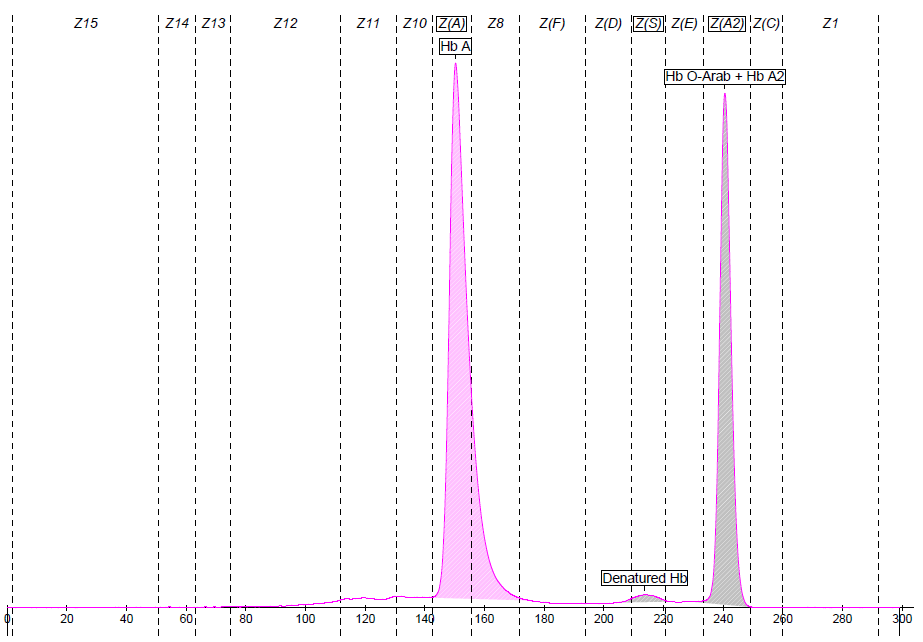
241
Sickle Cell Disease: No
Thalassemic variant: No
Capillary Electrophoresis
Fractions
Value %
Hb A
63.3
Denatured Hb
1.0
Hb O-Arab + Hb A2
35.7
Comments
Mutation data
Heterozygous Hb O-Arab
Mutation
HGVS Nomenclature
Beta 121(GH4) Glu>Lys
HBB:c.364G>A
Hematological parameters
Name
Result
RBC Count
No information
Total Hemoglobin
Normal
MCV
Normal
MCH
Normal
Blood smear
No information
Other analysis
No information
Comments on hematology
Normal
Clinical context
Clinical presentation
Normal
Clinical risk
Causes severe Sickle Cell Disease in combination with Hb S. Leads to a mild anemia and microcytosis in Compound Heterozygous status and chronic hepatitis, hemolytic anemia, splenomegaly in Homozygous status
Variant information
Stability
Normal
Oxygen affinity
No data
Ethnicities in literature
Found in different populations in Africa and Eastern Europe, and more rarely in Asian populations: met in African-American families, Gypsy and Pomak groups in the Balkan countries including Bulgaria & Greece, in Arabian, Egyptian, Northern Sudanese, Moroccan, Tunisian, Turkish families, and several Black families from the USA, Jamaica, Italy, Albania, and Western hemisphere, and in a Chinese female from Guangxi Province
Comments on variant information
The rare variant Hb O-Arab has been found in combination with Hb S, Hb C, Hb D-Punjab, Hb G-Philadelphia, and with alpha and beta0-thalassemia. Also observed in the homozygous state in Gypsy families from Balkan countries.
Scientific Literature
Scientific references
- https://pubmed.ncbi.nlm.nih.gov/5915974/ Vella F. et al., Nature. 1966 Jan 15;209(5020):308-9.
- https://pubmed.ncbi.nlm.nih.gov/5481775/ Milner PF. et al., N Engl J Med. 1970 Dec 24;283(26):1417-25.
- https://pubmed.ncbi.nlm.nih.gov/1112610/ Kantchev KN. et al., Humangenetik. 1975;26(2):93-7.
- https://pubmed.ncbi.nlm.nih.gov/893136/ Efremov GD. et al., Hemoglobin. 1977;1(4):389-94.
- https://pubmed.ncbi.nlm.nih.gov/10205993/ Vassiliadou D. et al., Folia Med (Plovdiv). 1998;40(3B Suppl 3):46-50.
- https://pubmed.ncbi.nlm.nih.gov/10203101/ Zimmerman SA. et al., Am J Hematol. 1999 Apr;60(4):279-84.
- https://pubmed.ncbi.nlm.nih.gov/31973650/ van Gammeren AJ. et al., Hemoglobin. 2020 Jan;44(1):61-63.
- https://pmc.ncbi.nlm.nih.gov/articles/PMC13717739/ Yang W. et al., Mol Genet Metab Rep. 2026 Oct 20;49:101371.
Globin Chain involved
Status
The term "Double Heterozygous" refers to cases of heterozygosity on different globin chain types, while the term "Compound Heterozygous" refers to cases of heterozygosity on the same globin chain type.
For example, S/G-Pest is a Double Heterozygous case (beta and alpha-globin chains are mutated) and S/C is a Compound Heterozygous case (only beta-globin chains are mutated).
Migration zones
Migration positions
In some cases (homozygotes, combination of the variant with thalassemia, transfused patients, degraded samples or unstable variants), the variation in the migration position may be greater than +/- 1 point.
For profiles with thalassemia, only Hb A2 and Hb F peaks, if present, are listed with migration positions.
Sickle Cell Disease
Thalassemic variant
Capillary Electrophoresis
Variant information
Ethnicities are provided for informational purposes only and are based on scientific literature and conference posters.
A hemoglobin variant may therefore be present in populations of ethnic origins or countries not listed here.
Hematological Parameters