

General information
Globin chain involved
Status
Compound Heterozygous
Migration zones
Migration positions
207
Sickle Cell Disease: No
Thalassemic variant: No
Capillary Electrophoresis
Fractions
Value %
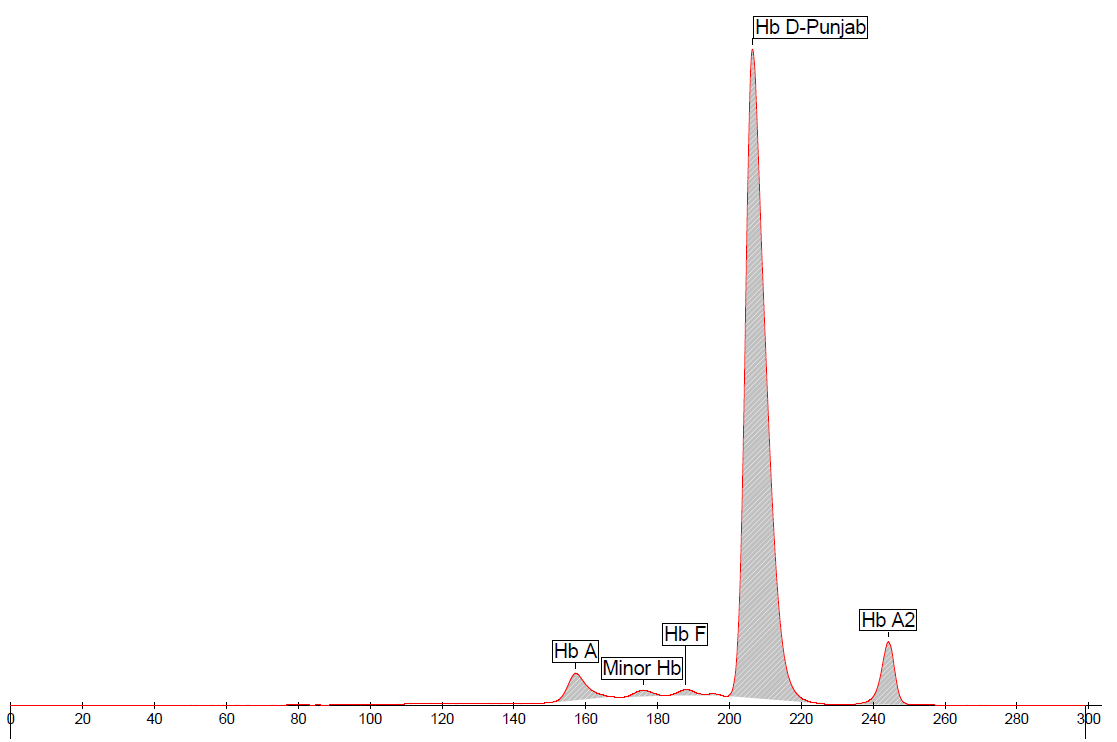
Hb A
3.3
Minor Hb
0.7
Hb F
0.7
Hb D-Punjab
89.5
Hb A2
5.8
Comments
Compound heterozygosity for Hb D-Punjab and Beta+-thalassemia, resulting in a significant reduction in the Hb A fraction and a very low amount of Hb F, prevents the profile from being centered (no zone displayed). The remaining fractions are nevertheless fairly close to their expected positions.
Mutation data
Compound Heterozygous Hb D-Punjab
Mutation
HGVS Nomenclature
Beta 121(GH4) Glu>Gln
HBB:c.364G>C
Beta+-Thalassemia
Mutation
HGVS Nomenclature
Indeterminate mutation
No information
Hematological parameters
Name
Result
RBC Count
Normal or elevated
Total Hemoglobin
Low
MCV
Low
MCH
Low
Blood smear
Thalassemic smear
Other analysis
No information
Comments on hematology
Mild microcytic and hypochromic
Clinical context
Clinical presentation
Asymptomatic to mild anemia symptoms
Clinical risk
No clinical or hematological alterations are observed in cases of heterozygosity or homozygosity.
Severe risk of developing Sicke Cell Disease in combination with Hb S, since Hb D-Punjab enhances Hb S polymerization
Variant information
Stability
Normal
Oxygen affinity
Normal
Ethnicities in literature
While homozygosity for less common hemoglobin variants is rare in non-consanguineous couples, compound heterozygosity can be more frequent. The Hb D-Punjab / Beta-thalassemia combination is common in Asian, Indian, and Silk Road populations and should be distinguished from cases of homozygosity.
Comments on variant information
The common variant Hb D-Punjab has been found in combination with Hb S, Hb C, Hb E, Hb O-Arab, Hb D-Iran, beta-thalassemia, alpha-thalassemia (including Hb H disease), and in the homozygous state.
Scientific Literature
Scientific references
- https://pubmed.ncbi.nlm.nih.gov/5672850/ Schneider R.G. et al., Blood. 1968 Aug;32(2):250-9.
- https://pubmed.ncbi.nlm.nih.gov/12403491/ Fucharoen S. et al., Hemoglobin. 2002 Aug;26(3):261-9.
- https://pubmed.ncbi.nlm.nih.gov/19233839/ Higgins T.N. et al., Am J Clin Pathol. 2009 Mar;131(3):357-62.
- https://pubmed.ncbi.nlm.nih.gov/23425159/ Belhoul K.M. et al., Hemoglobin. 2013;37(2):119-23.
- https://pubmed.ncbi.nlm.nih.gov/28970692/ Panyasai S. et al., Asian J Transfus Sci. 2017 Jul-Dec;11(2):199-202.
- https://pubmed.ncbi.nlm.nih.gov/29365076/ Riou J. et al., Am J Clin Pathol. 2018 Jan 29;149(2):172-180.
- https://journals.lww.com/jmsc/fulltext/2023/25011/review_of_clinical_and_hematological_profile_of.14.aspx Singh, Neha Lt Col1 et al., Journal of Marine Medical Society 25(Suppl 1):p S74-S79, June 2023.
Globin Chain involved
Status
The term "Double Heterozygous" refers to cases of heterozygosity on different globin chain types, while the term "Compound Heterozygous" refers to cases of heterozygosity on the same globin chain type.
For example, S/G-Pest is a Double Heterozygous case (beta and alpha-globin chains are mutated) and S/C is a Compound Heterozygous case (only beta-globin chains are mutated).
Migration zones
Migration positions
In some cases (homozygotes, combination of the variant with thalassemia, transfused patients, degraded samples or unstable variants), the variation in the migration position may be greater than +/- 1 point.
For profiles with thalassemia, only Hb A2 and Hb F peaks, if present, are listed with migration positions.
Sickle Cell Disease
Thalassemic variant
Capillary Electrophoresis
Variant information
Ethnicities are provided for informational purposes only and are based on scientific literature and conference posters.
A hemoglobin variant may therefore be present in populations of ethnic origins or countries not listed here.
Hematological Parameters